By MEDELPHARM S.A.S
Subscribe to Supplier
Subscribe to Supplier

Time machine: Medelpharm STYL’One Small Scale Development Tableting Instrument
Medelpharm’s revolutionary STYL’One rotary press simulator provides tablet developers with a ‘time travel’ window into their future production, allowing full-scale high speed tableting runs to be accurately modeled from tiny samples.
In this way, STYL’One helps deliver perfectly reliable development in the most cost-effective manner, demanding minimal cost, labor and materials.
STYL’One is the ultimate tableting instrument for small-scale development, testing each critical process parameter (CPP) to the highest standards of precision and reliability.
Features and Benefits
Rotary press simulator STYL’One Evolution gives you the ability to model future production with high accuracy without expending huge amounts of material to simulate full-scale tableting. Models can be generated on very small-scale batches down to single tablets using exactly the same parameters that will apply on the chosen high-speed press.
Similar production geometry produces truly representative tablets that can be reliably tested for dissolution, stability and elastic recovery.
Many different things can happen to tablets under the stresses of production (capping, sticking, etc.). The STYL’One allows manufacturers to see these outcomes at very small scale and make necessary changes before committing to the high costs of full-scale production.
STYL’ONE delivers a series of user benefits:
- Allows users to pre-develop a product perfect for production
- Manual feed capability that accepts powder in spoon-size quantities
- Produce results that can then be analyzed by a pharmacist to see how the powder is working
- Capability to model a range of process variables (i.e. when more force is applied, more punches, etc.)
There are also other methods to achieve a perfect scale-up f. e. with the help of the STYL’One Dry Granulation Software Package:
- Allows the formulator to produce ribbon samples rapidly at given solid fractions and simulating a target roll compactor
- Simulate variables like roll gap, speed and hydraulic pressures
Background
New focus on small-scale development has become irresistible with the rising costs of new formulation development due to regulatory demands for expensive testing, increasing demands of Quality by Design (QbD) and pressures to shorten development cycles. All these factors require manufacturers to do more with less, particularly in minimizing use of expensive materials and sample batches. The need is for tableting equipment that can deliver better research samples while consuming less API.
Small-scale development encompasses those technologies that enable large-scale industrial process efficiencies at small-scale quantities, relating to tablet size, batch quantity, or amount of powdered materials needed to generate the complete study sample.
In early stages of dry granulation, powder is scarce, expensive and not there in quantities demanded by industrial scale production presses, which use multi kilo-size loads.
Medelpharm has become a leader in the small-scale dry granulation segment, evolving from its original rotary presses toward rotary press simulation and small-scale solutions. The portfolio evolved in 2008 with new machines that could simulate multi-layer presses and roll compactors, enhanced by Analis software package offering automated studies to browse the target design space.
Every Medelpharm instrument, accessory and study is designed with material saving in mind. Enabling smaller scale pilot compactions increases the precision and scope of modeling by generating more data points on the curve. Testing these CPPs is essential for a QbD approach that requires more numerous targeted experiments as part of the overall design program. Published mathematical formula help designers to extrapolate physical parameters for tablets that can include tablet weight, size and shape.
When direct compression doesn’t work, manufacturers naturally wish to explore roll compaction. Small-scale development provides the answer by allowing compact-ability of formula to be tested in roll compactor with minimum expenditure of resources and effort.
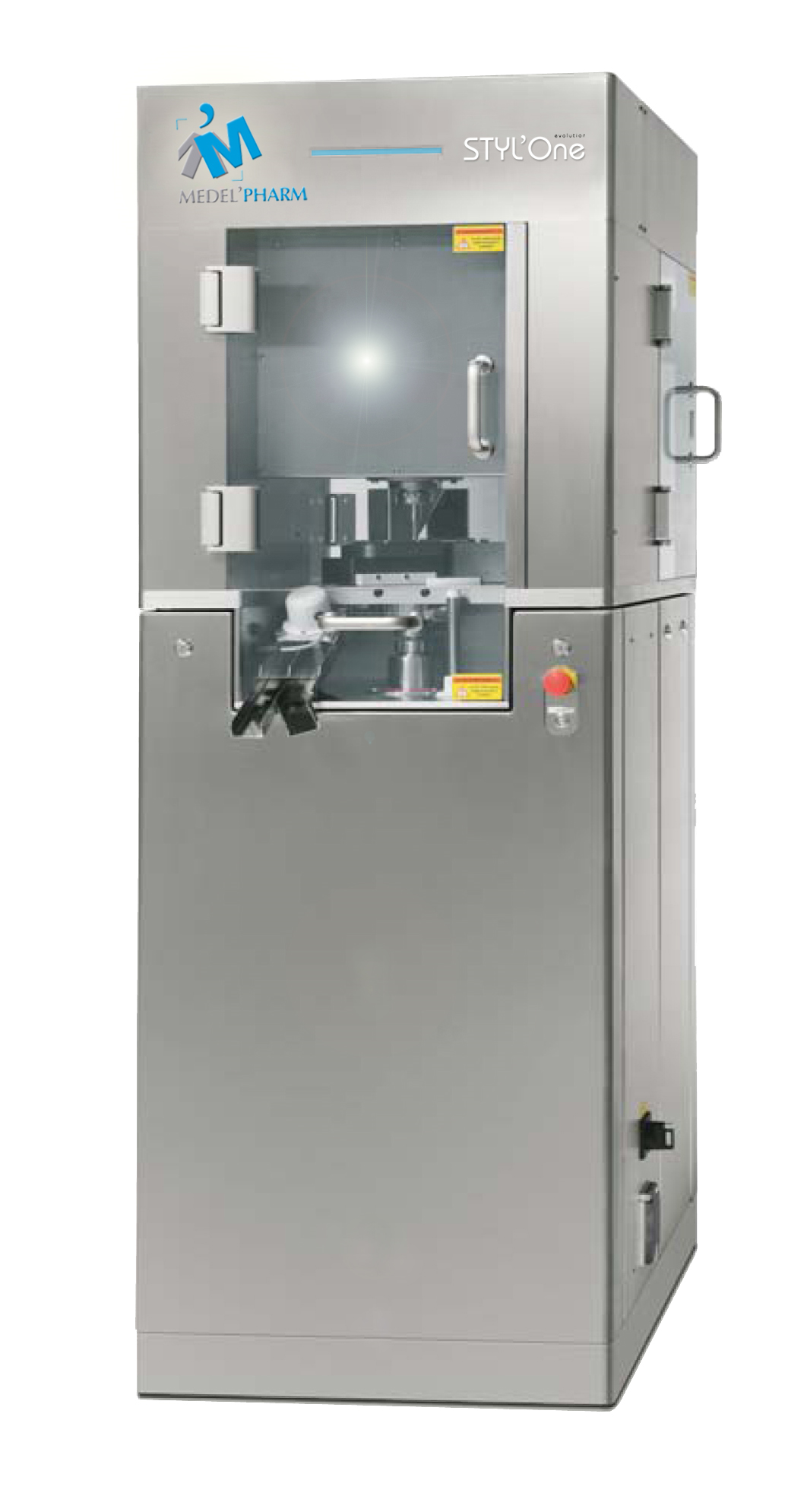
Styl’One Evolution
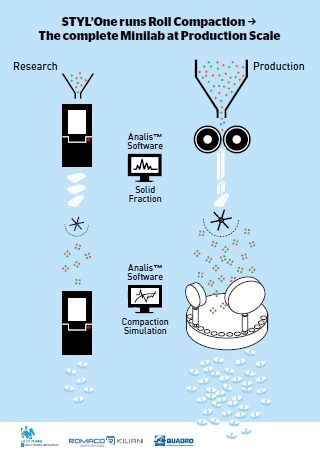
STYL’One runs Roll Compaction – The complete Minilab at Production Scale
Related Articles